|
PHOTO TOUR My photos are protected by digital watermarking and can be tracked. All content subject to copyright. All rights reserved. Contact me here
|
 **
**
|
Hamptonne
Country Life Museum Hamptonne House, the
surrounding buildings and land were bought by the National Trust for Jersey
in 1987 and after archeological investigation and restoration work by the La Société Jersiaise, opened to the public in 1993. Hamptonne takes its name from the family who lived in the main property from 1633 onwards - Laurens Hamptonne being the first to proclaim Charles II king in February of 1649. |
|
|
Agriculture was the
backbone of island life for hundreds of years with farms being passed from
father to eldest son through each successive generation. Hamptonne Country Museum,
now run by the Jersey Museums Service, aims to show this important part of
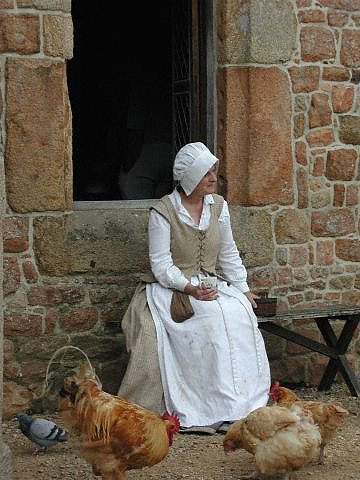
our heritage in an enjoyable and realistic way. On the left is the 'Goodwyf'
who is often on hand to pass on the latest gossip of the community and
explain the cooking and traditions of the age. Other staff, also suitably
dressed in traditional clothing, give demonstrations of local crafts and
guided tours. Hamptonne house is fully open to the public to wander around and has been restored, complete with authentic furniture and simple ornaments relating to the 17th century. |
|
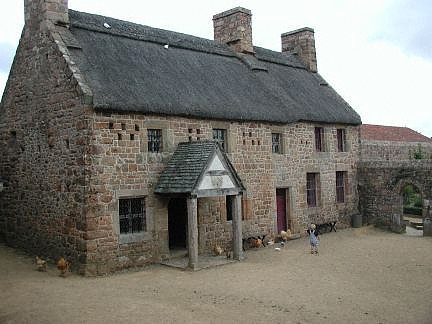
The house has been
changed several times over the centuries. Originally it would have been one
large room, open to the rafters. A second floor and stair tower to allow
access were built during the sixteenth century, and a dower wing added at the
end of the seventeenth century. Life in the 1640s is depicted in the main house, and in the 1730s in the dower wing. |
|
|
Initially, farmers produced cider for their own consumption, but gradually more and more land was planted to orchards, and cider was produced in vast quantities. By 1795 almost 20 per cent of Jersey's land area grew apple trees, leading the author Poingdestre to comment: 'The whole island is in danger of becoming a continual orchard.' |
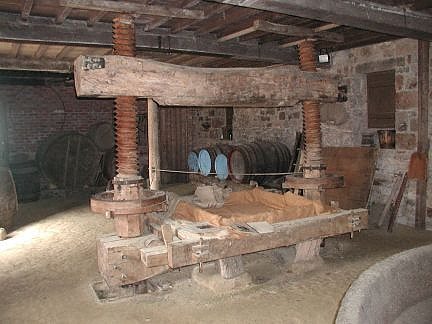
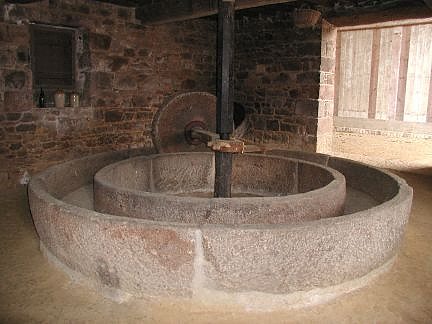
The Syvret Building
(adjacent to the main farmhouse) dates back to the 1830s and houses a large
apple crusher (below) and twin-screw apple press (left). |
|
By the mid 1800s every
farm had its own apple crusher and press, and large quantities of cider were
being exported to England. All of the equipment in
the Syvret Building is in working order and is used each October to produce
Hamptonne's own cider. . |
You can read a little
more about our cider industry and, in particular, the production of 'Black
Butter' (a local apple jam) by clicking here |
|
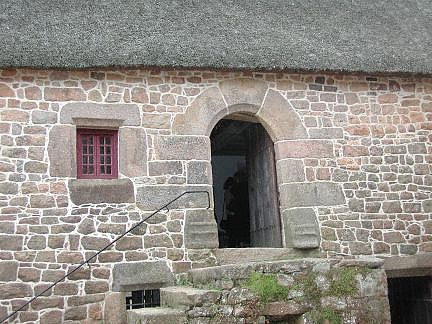
The stone arched doorway
is an example of the 'Jersey arch', most examples of which comprise nine
stones. This one is unusual in that it has eleven. Life in the eighteenth century is depicted in this particular building. |
The 'Langlois House'
which forms part of this group of buildings is typical of the style of
architecture common in medieval Brittany. The living accommodation is
upstairs, whilst animals and stores were kept downstairs. |
|
|
|
|
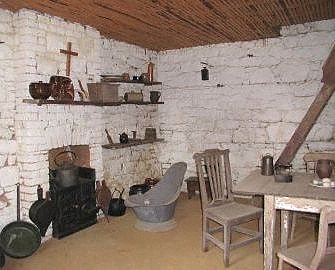
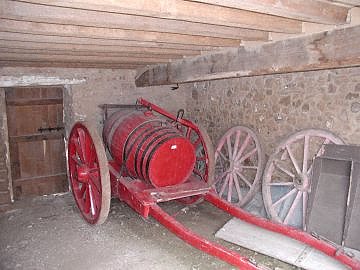
Of course many farms had
labourers to help tend the land, and their living quarters were considerably
less salubrious than the main house. Rooms in some of the outbuildings show
what life was like for the farm hands (above left) and, as you would expect,
there are farm implements, carriages, stables, vegetable and herb gardens and
various farm animals to see. The Jersey Museums
Service has obviously tried to make a visit to Hamptonnes like stepping into
a time warp and I think they've done a good job. I particularly like the fact
that there are people in period costume ready to explain aspects of their
lives in the various time zones. This museum is part of the Jersey Heritage Trust and discount tickets are available if you intend visiting several of their sites. |
|
|
Jersey crest graphic, photos and all written content on this site subject to copyright. All rights reserved. Contact me here. My photos and graphics are digitally watermarked and can be traced |